Thanks to the ruggedness of Ambrym’s terrain and the actions of its volcano, the villages here are said to have clung tighter to the “kastom” lifestyle as well as their mystical beliefs. In particular Ambrym is famous for its ROM dances, mysterious cult dances performed to appease spirits by male dancers wearing elaborate headdresses…(and little else!) In August, the village of Olal at Ambrym’s northeastern-most corner hosts a “Back to Your Roots” ROM dance festival for outsiders as a means of raising money for secondary education and as a way of keeping “kastom’ traditions alive.
Also thanks to the ruggedness of Ambrym, winds gust down the mountainous slope in “wind bullets” that thrust the boats in the anchorage this way and that, while rain showers keep them perpetually misted and lit by rainbows. By the start of the festival on August 20, thirty plus boats had assembled in the anchorage off Nebul village (S16*06’.5; E168*.07’.7), an area protected from the trades by the tip of the island and a curve of reef. Olal, however is several miles further north on the unprotected tip, so at 0830 Wednesday morning the cruisers gathered on the beach, dragging their dinghies above the tide line with the help of muscular villagers, and set out to walk the track in the drizzle. Fortunately for us, we were approached by one of the chiefs who shook our hands and suggested we take a guide, who happened to be one of the men who helped beach the dinghy. Micah, who stuck with us the entire three days of the festival, showed us the sights as we walked, carried one of our collapsible chairs when its sling broke, and steered us to short cuts saving us ten minutes on an otherwise hour-long walk.
The festival took place in a cleared glade in the woods fairly far from Olal village. The dance area was much smaller and more intimate than what we’d seen in Lapo, as well as wilder and more mystical as sun and mist alternately filtered through the trees. Around the edge was bamboo pole seating, and behind the “stage” blending into the trees was an array of slit drums and “tiki-like heads” known here on Ambrym as “atingting.” Through the trees one could just make out a staging area where the dancers prepared themselves while to the right was the nassara, a sacred and decorated building where the ROM members gather and women are tabu. There were also three “concession stands” – booths of palm fronds – in the woods behind the seating where Don was able to indulge in drinking coconuts and fried dough in three or four different forms over the course of the next three days – and some “outhouses” I never did check out.
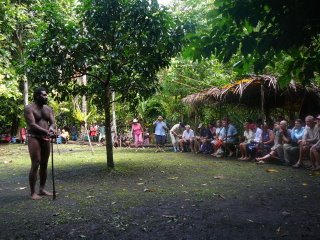 If there was one thing that made this festival stand out from the others it was the tall and solid person of Chief Norbert (pronounced Nor-bear in the French way), principal of the Olal Secondary School and master of ceremonies for the performances. At the start of things that first day, and before every major presentation, Norbert calmly walked out before the audience, utterly at ease in his Kastom attire of penis wrap and little else, and clearly explained what we were going to see and why it was important in both English and French that we could hear and understand without a megaphone. More than an emcee, Norbert participated in every dance presented, and he did so with more gusto than any of the others. In fact that would be the second thing that really distinguished this festival, the fact that most of the dancers seemed to be having a helluva good time.
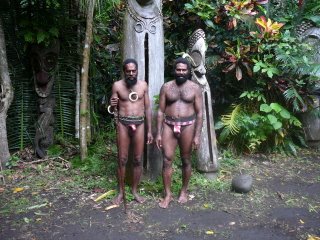 The main dance of the first day was a grade-taking ceremony for a chief. What made it unusual was that the area’s high chief, Chief Sekor was repeating the first level grade – that of the sacred fire. Although Chief Sekor is actually a grade seven chief, he had lost respect by violating the tabu of grade one – sharing food. Apparently all these chiefs after grade one must prepare their own food on a separate fire and eat separately from anyone else, including their own families! So, Chief Sekor was repeating the ceremony to get his full status back.
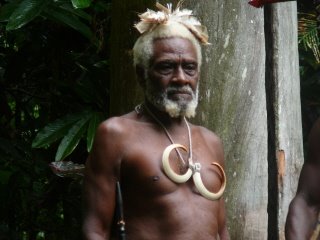
How to describe for you the dances we saw, let alone any one dance?! Well this first dance was distinguished by only being danced by chiefs. There were probably a dozen of them of a wide range in age, all in kastom dress of namba (the penis wrap of woven leaves in perpetual erection) attached to a woven belt, with the rooster tail of leaves firmly attached to the backside above their buttocks. Some wore the coveted boar teeth necklaces and some carried impressive staffs and some had smears of red paint on their faces. The two main elements of all the dances were harmonic chanting by the men, usually in response to a solo lead, and vigorous stamping of bare feet, in various cadences, that vibrated through the ground. Some of the dances danced to the beat of the large slit drums, some to a smaller portable slit drum, and some to no drum at all. Most of the dances are danced with the men in a tight circle, almost a huddle, so that the audience is presented with an array of backsides. Odd at first, it is a powerful statement of communal strength (and bare butts are pretty fascinating given the time and opportunity to study them!). At one point in the doings,
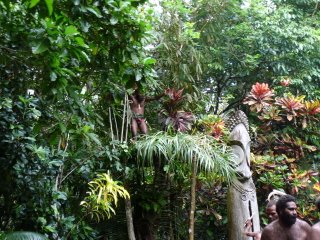 Chief Sekor climbed to a platform some twenty feet up and the dancers took turns throwing coconuts to dislodge him, mostly symbolic, choreographed lobs, but one did catch him on the thigh. And in the end, he did have to kill a pig for the ritual sacrifice to seal the deal. This time it was a little porker…I guess because he was repeating first grade!
The second dance of the day was a woman’s dance. Here the ladies were in full grass skirts and naught else but perhaps a thin garland of leaves around their upper body. Sadly for the men in the audience, these were still not the young and shapely maidens of South Pacific fantasies, but at least they all seemed more at ease with their shift from western dress than the women in Lembinwen did. The women also dance to their own chants, but instead of stamping, their step is a skating slide of bare feet on the dirt that makes a sort of swishing sound, and most leaned on a slim staff, for an effect rather like dancing with a swaying broomstick.
The second day’s main dance was a dance from the yam harvest. A young man, who doesn’t sleep for two days and who gets a special hairdo, wears an awkward pyramid of a headdress symbolizing the yam. (Incidentally, the yam is a pretty major food crop in these parts, and according to Micah the name Ambrym comes from Capt. James Cook’s arrival when he was presented with the traditional welcoming gift of a yam, and the word “ambrym,” which in the local language means “for you.” Nice, don’t you think?) This dance was performed with the dancers facing the audience, and several dancers did solo turns impersonating various creatures like prawns or birds.
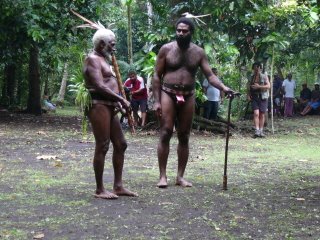
After the Yam Dance, one of the chiefs, a man who truly personifies dignity, performed for us on the bamboo flute. WE subsequently bought one of these, and I can barely get out one tone!
The other main event of day two was a meal prepared by all the dancers. The women repaired to one side and lit a fire to cook cassava and make something with greens and coconut milk, while the men lit their own fire on the other side of the grounds and roasted breadfruits in the flames, which they then peeled and then, on great wooden boards, kneaded with a coconut rolling pin until the cooked breadfruit flesh transformed into a soft puffy dough the size of a double giant pizza.
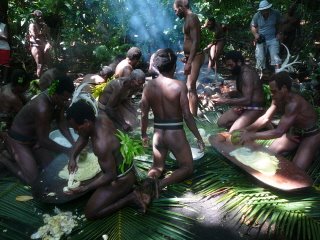
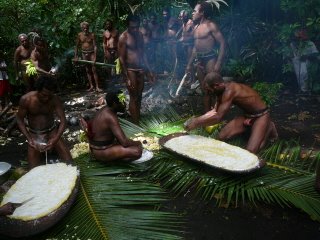 Then they scored the dough into bite-sized diamonds and drizzled it with hot coconut cream, also, of course, produced by hand. The result was surprisingly light and tasty, and most of us went back for seconds and thirds. The women were still peeling the cassavas when Micah spirited us out for an early look at some carvings being offered for sale, so we didn’t get to sample whatever it was they were making.
The carvings were being set up for purview down in the Olal Yacht Club (yes, they have one too.!) The Olal Yacht Club is on a bluff overlooking Selwyn Straight, the channel between the north tip of Ambrym and Pentecost Island. There is tiny “anchorage” down below, but it’s not one you would ever want to put the hook of a cruising sailboat down in. The reinforced tradewinds had rolled in since our arrival two days before, and the straight and anchorage were a mass of whitecaps and spindrift. No wonder we were walking three miles each way!
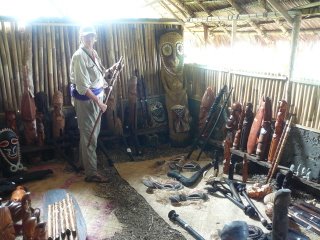 The carvings on display were fascinating. Each day of the festival there were more and more as locals caught on there were buyers afoot. Note, it wasn’t just cruisers attending the festival. Some intrepid tourists (including a camera team from French television) had flown into the airport at Craig’s Cove, transferred here by fast boat, and were staying in the village. Unfortunately, other than knowing that Ambrym carvers are renowned in Vanuatu and that most every figure on display was a reproduction of some traditional artifact, we didn’t have a clue what we were looking at. Also, unfortunately, we didn’t have enough cash to buy much of anything. Too late, after the end of the festival, Chief Norbert passed out a museum quality booklet prepared for an exhibit of North Ambrym ritual art just finishing at a gallery in Sydney that pretty well explained everything (including what a ROM dance is!—Chiefs Norbert, Sekor and the whole dance troupe actually were brought to Sydney to perform for the opening last month! That must have been an eye-opener!). (The booklet shows that the gallery has a web address that might have an online version for those of you who are curious…it is www.annandalegalleries.com.au )
 So what is a Rom dance? Although we were all there to see it, I suspect very few of us had a clue. According to the museum booklet, Rom is one of three “secret societies” that controls and manages Ambrym’s mystical kastom culture. Of the three – Mange, Temar and Rom – Rom is the most open, with some of its dances occasionally presented for outsiders like us. I quote from the Annandale Gallery booklet:
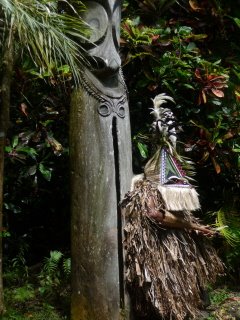 Adult Rom masks are always danced by men who are invisible beneath floor-length banana leaf costumes as they represent powerful spirits rather than living men. There are many different types of Rom mask and each man who wishes to dance one must pay for the privilege of making it and wearing it. … The typical Rom mask has a sharp, angular face with a prominent lower jaw that juts out of a cone-shaped fiber-covered head dress at an angle of 45 degrees. The complexities of different grade rankings are communicated by variations in the patterns and colors with which the faces are painted and by the design of the ridge running up the center of the mask.
Our Rom dance began “off stage” 100 meters down a path leading to the nasara. Chiefs Sekor and Norbert and the troupe of uncostumed dancers began the chant in a very tight pack surrounded by eight spirit figures.
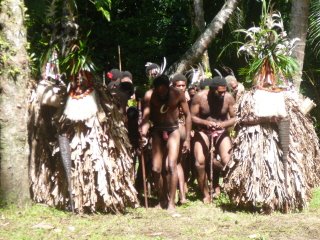 It took them quite a while to reach the dance ground proper, and unfortunately this led to the audience filing from their seats with their cameras and blocking the view for everybody else, which, also unfortunately, let to temper flare-ups and a lot of pissed off people. Of course, the dancers did finally arrive, and we all saw plenty of them as the spirits swished back and forth in various patterns each carrying an unusual woven staff/rattle that leant them a two toned mystical sound, while the singers chanted and stamped indefatigably.
This obviously is not the dance of a professional ballet, Broadway or even folk-dancing troupe, but the chants and the stamps get in you head, hypnotically melding you into a scene you couldn’t even have imagined before you came. The bludgeoning of the pigs – yes, another one, sending several youngsters into tears – is no westerner’s favorite part, but we are here to see their traditions; it’s not that they are not putting a show on for us.
After the Rom dance came a short magic session. They only did three “tricks” because they have their own magic festival at a separate time. I was imagining something a little more witchcraft-y, but the three tricks were actually rather agricultural. For me, the best was the first, where two men planted the top of a taro root with its attached cluster of leaves, poured some spirit water on it from a coconut shell and unearthed a full grown tuber! Hmmm. The second trick was a similar one with a yam, starting with a vine, and the last one was a water trick where they poured water into one length of bamboo and poured it out of another!
Chief Norbert – aka headmaster Norbert – closed the festival by explaining that the monies earned from the (fairly stiff) festival entry fee goes into a fund for education of the area’s kids, mostly funding students to secondary school.
The show ended with a public dance, where everyone was invited to get up and join the dancers – stamping or swishing as our gender dictated. Don was exempt with a sore foot, but I did my best to swish with the ladies, although Don says I was seriously overdressed.
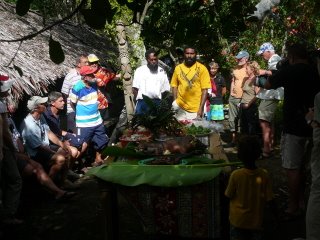
Afterwards, Chiefs Norbert and Sekor hosted the cruisers to a feast at the yacht club. We had roast pig (most likely the porker from the first day) and two table loads of chicken, yam, cassava, salad, green beans, rice, fruit salad and the like. We all lolled on the lawn overlooking Selwyn straight and gobbled to get out platefuls down between showers.
The furiously strong winds stirring up the waters out in the open finally began to subside yesterday in time for boats to raise anchor and sail away. We said “Fair Winds” to Procyon, who took off for a night passage back to Port Vila and onward to New Caledonia. On Tackless II, we took Saturday to unwind, to snorkel the surrounding reefs, and, of course, to catch up on this log. Tomorrow, we head further north.
Seeing the festival in context with having read your most recent article in Lats & Ats re: 'giving back' makes me realize even more that it is our sacred duty NOT to disturb the local peoples way of life - naturally in order to do that in the purest sense we would never go there but given that - we can do as little as possible not to uproot their life styles. They seem very content as is. And got along very well b4 us. Great experience for you - nice.
ReplyDeleteBill C
s/v Geodesic2